

In a franchise as dense and prolific as Resident Evil, there’s bound to be a buffet congealing on the cutting room floor. The series’ abandoned games have become the stuff of legend; a discarded drafts folder that includes ports that pushed classic hardware past its limits and phantom prototypes for consoles that never made it to the West.
While the name Resident Evil is often considered synonymous with PlayStation, thanks to the series getting its start on Sony hardware, Capcom’s survival horror has had a comfortable relationship with Nintendo across the years. While that collaboration is beloved for birthing the once GameCube-exclusive Resident Evil 4, there have been a couple of less-successful ventures on Nintendo consoles.
Resident Evil has never been a stranger to handheld hardware, though its early track record came with casualties. The series’ portable debut on Tiger’s doomed, ignominious Game.com device in 1998 bode ill for Resi’s viability in one’s pocket, but Capcom wasn’t about to give up on the idea of carrying survival horror around in your shorts.
The hardware wasn’t making it easy, though. Handheld gaming was in its AA battery and magnifying lens era, a time of chunky underpowered devices with atrocious screens and inadequate backlights. None were obvious candidates to host one of the PlayStation’s most atmospheric games.
In 1999, Capcom hired a small London-based studio called HotGen to shrink Resident Evil down to the Game Boy Color’s 2.3-inch screen. Such a feat could, theoretically, be accomplished two ways:
- Create a bespoke port that plays to the GBC’s strengths, perhaps a top-down experience akin to its 8-bit ancestor, Sweet Home.
- Attempt to cram a 514 MB CD-ROM into an 8 MB Game Pak.
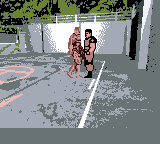
HotGen chose the latter, and they very nearly pulled it off. The team recreated hundreds of Capcom’s pre-rendered backgrounds for the GBC’s 160x144 pixel, 56-color display. Characters scaled dynamically with depth and distance on a CPU that was designed in 1974. The results were ugly by any reasonable standard and astonishing by every other– it really was the entire PSX game squeezed inside a translucent plastic slab the size of a matchbook.
The project reached near-completion before Capcom pulled the plug, citing concerns about the final product’s appeal. One developer has hinted that one of Resident Evil’s “original creators” didn’t think the port was worthy of their achievement. Whatever the reason, whoever made the call, they failed to keep the game buried forever.
An incomplete build leaked in 2011, functional but rough. In December of 2025, preservation site Games That Weren’t surfaced a 98% content-complete build provided by assistant programmer Pete Frith. It’s missing a few months of polish, but it’s entirely possible to clear Jill Valentine’s complete campaign, from the Spencer Mansion’s welcome mat to scraping Tyrant guts off her boots.
One developer has hinted that one of Resident Evil’s “original creators” didn’t think the port was worthy of their achievement.“
Capcom quietly replaced the cancelled port with Resident Evil Gaiden in 2001, an original GBC title developed by M4, set on a cruise ship and built from the ground up for the aging portable hardware. Gaiden feels like a stopgap and is largely forgotten, overshadowed as it was by the launch of the Game Boy Advance.
The GBA never received a Resi game, though some Italian developers pitched a port of Resident Evil 2 for the platform. Capcom passed on their demo and decided to tackle Resident Evil’s handheld future on its own. It was the right call.
Resident Evil: Deadly Silence delivered the original experience in a convenient clamshell case, using every loveable gimmick of Nintendo’s DS in a new Rebirth mode alongside the untouched 1996 classic. Later, Resident Evil: Revelations on 3DS would fulfill the franchise’s promise of full-blooded survival horror experiences on the go. The modern RE Engine takes it even further, with today’s flagship Resi titles running beautifully on powerful PC hardware like the Steam Deck. You can even get the modern trilogy of games – Biohazard, Village, and this year’s Requiem – on Switch 2. We’re a long way from squinting at a worm-light in the back seat of grandpa’s car.
Resident Evil, it turns out, can run on almost anything. Even the Nintendo 64. Capcom contractor Angel Studios miraculously compressed 1.2 GB of Resident Evil 2 onto a 64 MB cartridge, including its CG cutscenes – unheard of on the N64 – with extra features and high-res graphics courtesy of the almighty Expansion Pak.